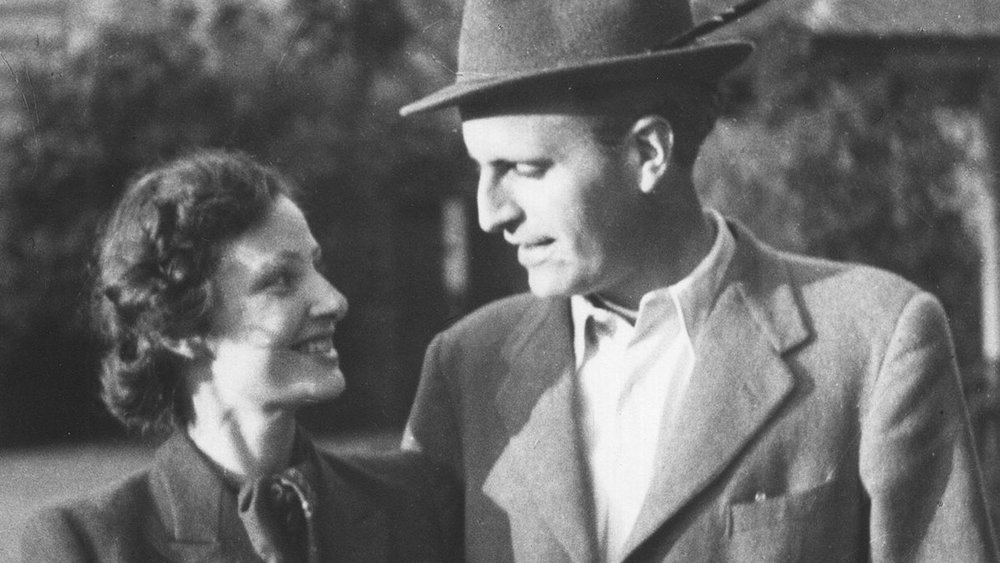
"We must not only defend democracy against populists and right-wing extremists. We must also defend it against our own fear."
Eva-Maria McCormack, Member of the Board, Adam von Trott Foundation, Imshausen e.V.
Can we imagine the scene 80 years ago in spring? Night after night, bombers cross the sky. It has been obvious for months that Germany is losing the war. The von Trott family's estate in Imshausen is overcrowded with refugees. The von Trotts may be aristocrats, but everything is scarce. Clarita von Trott, who has moved here to escape the Berlin bombing raids, is looking for food, clothes and soap to wash her young daughters' diapers.[1] She is happy to receive every letter from Adam, her husband, from Berlin. There are only a few months left until Hitler's assassination on July 20, and only one more until Adam is executed for his role in the resistance.
But so far Adam is in Berlin. The war has become apocalyptic here, he writes home to his mother.[2] His secretary Hilde Walter has just perished along with her sister and parents when a bombing raid hit their apartment, he tells Chris Bielenberg, his and Clarita's close friend, who pays him a surprise visit. She has also fled Berlin with her young children. Adam's housekeeper Emma has conjured up a soup from leftovers. She smuggles her few pieces of meat onto Adam's plate because he looks miserable and emaciated.[3]
The future and futility
Adam and Chris talk about his futile efforts to find support for the resistance from the British and American governments. He has traveled to Sweden and the Vatican to make contacts and deliver a memorandum of resistance - always at the risk of his life, but in vain. Hardly anyone seems to be listening.
And yet: "Do you see, Chris, why we have to plan ahead? Why we have to plan for what's coming, for what's coming after"[4]he says to Chris, the friend from England. Just under a year ago, Adam took part in the last major resistance meeting on the estate of Helmuth James and Freya von Moltke in Kreisau. For three days, the resistance fighters discussed their plans for a democratic Germany after the war. For Adam, the talks were like a gift - and they were exhausting[5]It is hard to imagine social democrats and conservatives, aristocrats and trade unionists, Protestants and Catholics sitting down at the same table. But over the last four years, everyone has been thinking and reflecting together: How do we build a new democracy? How do we shape a peaceful society? How do we want to live in the future?
A new Kreisau moment?
Today, eighty years later, it seems as if we are once again facing a Kreisau moment: war and violence dominate our headlines. The Western liberal order established since the Second World War is crumbling. Polarization and populism are undermining our social dialogue, the rise of the far right is undermining our democracy. Growing inequality is jeopardizing our social coexistence and exacerbating conflicts over resources at home and abroad. The pandemic has exhausted people across all generations. The multilateral institutions created to build international consensus are being torpedoed by new nationalisms and geopolitical rivalries. And the climate crisis hangs over everything as the biggest new distribution issue of our time: we are seeing more and more irrefutably that our way of doing business and living is endangering our earthly home and thus our livelihood.
"Everything affects everyone at the same time"[6]Adam Tooze describes the collective experience today - and in view of this "polycrisis"[7] we are once again faced with the challenge of finding a new consensus: How do we want to live? What values should our future be based on? What needs to change to enable more fairness, more inclusivity and fairer participation for all? In other words, a way of living together that can also guarantee stability, security and long-term sustainability?
Hoping in the dark
What inspiration do Adam von Trott and the resistance of the Kreisau Circle offer in our polycrisis today? Above all, we can rediscover the power of the "And yet" that Adam spoke about with Chris Bielenberg that evening 80 years ago. He and his companions in the Kreisau Circle not only lived in the middle of the war. They also had before their eyes every day how small the chances of their resistance were and how great the possibility was that they would achieve nothing and instead be imprisoned and executed. They knew fear - and yet they acted.
Today, on the other hand, we seem to be paralyzed by fear: according to recent surveys, 73 percent of people in Germany today find it difficult to imagine a better future.[8] What is even worse is that young people in particular are overwhelmed by fear: More than 80 percent of today's 16 to 25-year-olds believe they are facing a frightening future. Four out of five feel betrayed by their governments in the face of a lack of climate protection.[9]
When fear is tugging at your sleeve, it's difficult to envision new futures - and then work towards them. The story of Adam von Trott and the Kreisau Circle can be an encouragement to overcome this blockade as individuals and as a society. Hope is not naïve: it is the willingness to act in the open and the courage to recognize that the outcome is uncertain. But isn't that how all great social transformations began? Adam and his friends may have failed 80 years ago, but they continue to inspire today - and a look at history reveals countless examples of successful transformation, from something as small as the invention of the wheelchair to something as large as the Bill of Rights and the end of slavery.
"When we embrace uncertainty, we learn that we can influence what happens in the world - alone or with a few dozen or with millions of others," aptly wrote US historian and activist Rebecca Solnit.[10] It is also crucial: acting in the open also means not allowing the enemies of democracy to use their own fear as a weapon. Fear of the future and a perceived lack of prospects are the gateways for right-wing extremist narratives and populist seduction, as the descendants of the resistance - including Adam's daughters Verena Onken von Trott and Clarita Müller-Plantenberg - emphasized in a joint appeal for democracy this spring.
The power of diversity and dialog
The power of diversity and dialog is another Kreisau lesson that could not be more relevant today. Like the message of hope, it can inspire our behavior and our cooperation as citizens. At the same time, it is a task that those responsible in politics and civil society must urgently face up to. Adam and his fellow members of the resistance recognized the need to build bridges across differences and find consensus for the good of democracy and the common good.
This contrasts with the show-driven debates and cheap battles for even the smallest party political advantage that often seem to dominate the discourse of political leaders today. When political decision-makers, even from established parties, fuel social polarization, they ultimately undermine their own ability to shape the path to a better future and a better democracy through diversity and dialogue. The talks in Kreisau were exhausting and yet a gift, wrote Adam von Trott to his wife. Good governance is hard work and honest negotiation. Respect for differences is the bridge to common solutions. Kreisau can teach us that too.
[1]von Trott zu Solz, Clarita (1999-2004). An independent existence - The path is created while walking. Berlin, unpublished manuscript, p. 104.
[2]von Krusenstjern, Benigna (2010). "That it makes sense to die - to have lived": Adam von Trott zu Solz 1909-1944 Biography. Göttingen: Wallstein Verlag, 3rd ed, p. 487.
[3]Bielenberg, Christabel (1987). When I was German: 1934-1945. Munich: Verlag C. H. Beck, p. 145.
[4]Bielenberg (1987 ), p. 152.
[5]von Krusenstjern (2010), p. 475.
[6]Tooze, Adam (2023). "This is why 'polycrisis' is a useful way of looking at the world right now", World Economic Forum Mar 7, https://www.weforum.org/agenda/2023/03/polycrisis-adam-tooze-historian-explains/.
[7]Ibid.
[8]More in Common, Future Quiz 2023, https://www.moreincommon.de/unsere-arbeit/zukunftsquiz/.
[9]Hickman, C. et al (2021). "Climate anxiety in children and young people and their beliefs about government responses to climate change: a global survey". Lancet Planet Health 5: e863-73. https://doi.org/10.1016/S2542-5196(21)00278-3.
[10]Solnit, R. (2016). Hope in the Dark: Untold Histories, Wild Possibilities. Chicago, Illinois: Haymarket Books, p. xiv.